Solutions engineer · technical sales

Chris Keene

On paper I’m a solutions engineer, the technical half of enterprise deals and, to most of the teams I work with, their trusted advisor on accessibility rather than “the person selling to us”. But the title undersells it: I build the tools I demo, lead and level up the team around me, and shape new propositions end to end. The thread through all of it is making digital experiences genuinely work for everyone, without pretending the business case doesn’t matter. And I don’t just demo, I build, so when a deal gets technical and someone asks how it actually holds up, I can show them rather than talk at them.

Selected work

Most of this was built for clients, or lives behind a login, so I’ve kept the details vague on purpose. The work is real. The names just aren’t mine to give out. The ones marked Playable are mine, though, built for fun, and you can try them right here.

Accessibility ROI & maturity tooling

Interactive models that put hard numbers on a fuzzy question: what’s the business case for accessibility, and how mature is an organisation really? I run these live in technical evaluations to turn sceptical buyers into internal champions.

  • Sales enablement
  • Data modelling
  • Data viz

Onboarding & enablement platform

A gamified, multi-role ramp app: learning paths, spaced-repetition drills, role-specific quizzes, manager dashboards, streaks. Built to turn a messy onboarding process into something a whole team actually finishes.

  • Enablement
  • Front-end
  • UX
  • SPA

Accessibility regression harnesses

Record a user journey once, then automatically catch accessibility regressions on every change, for web and mobile. Shareable reports, CI-friendly, so fixes stay fixed instead of quietly breaking again.

  • Playwright
  • Automation
  • WCAG
  • CI

AI-queryable platform

An MCP server that wires a live accessibility platform straight into AI assistants. Instead of clicking through dashboards, you ask in plain English and get answers from the real data. Handy when a demo needs to go wherever the room takes it.

  • MCP
  • LLM tooling
  • Integration
  • Automation

AI assistant skills & pipelines

A whole library of reusable AI “skills” that take the unglamorous work off people’s plates: research, reporting, on-brand content, RFP responses, QA triage, mapping out buying committees. Most are shipped to an internal marketplace and used across the team, not stuck on my laptop.

  • LLM tooling
  • Automation
  • Marketplace
Playable

Empathy Challenges

A set of playable challenges I bring to accessibility events, built to make the barriers real instead of abstract: feel the web through a screen reader, race to fix a broken page, spin something up in a vibe-coding sprint, plus sudoku and a couple of sign-language games. Accessibility you experience, not a slide about it.

  • Empathy
  • Events
  • Interactive
  • Game design

Accessibility knowledge hub

A searchable hub that turns the sprawl of WCAG, success criteria, techniques and the rest, into something you can actually query, with a validation view that checks how a page stacks up against it. Less hunting through spec pages, more answers.

  • WCAG
  • Search
  • Reference
  • Data

Reports people actually read

Turning messy audit and usage data into clear, branded, interactive reports: the kind a non-specialist can open, understand, and act on without a translator in the room.

  • Data viz
  • Design
  • HTML/PDF

Community building & inclusion

I don’t just build software, I build communities. I led an OpenIDEO chapter, 300+ designers using human-centred design to tackle social-impact problems, and served as President of Abilityforce, championing disability inclusion across a global workforce.

  • Community
  • Human-centred design
  • Inclusion
  • Facilitation

On stage and in the room

The stuff I’m actually allowed to show: talks, workshops, shoots, and the odd good cause.

A day I ran with Scope on tech for disability inclusion. Genuinely my favourite kind of work.
Transcript

So we're here today for this event with Salesforce, it's a great opportunity co-producing change hopefully in terms of inclusive design. Today has been really fun to be with everyone in the design exercises and if we can bring more of that fun into how we create products and services that could be another great way for us to drive this change. So at Scope we can't do things on our own but what we can do is hopefully provide some of that expertise and really be part of that movement for change. It's really great to see Scope involved in these conversations and partnering with lots of different industries and sectors and the work they do is really important.

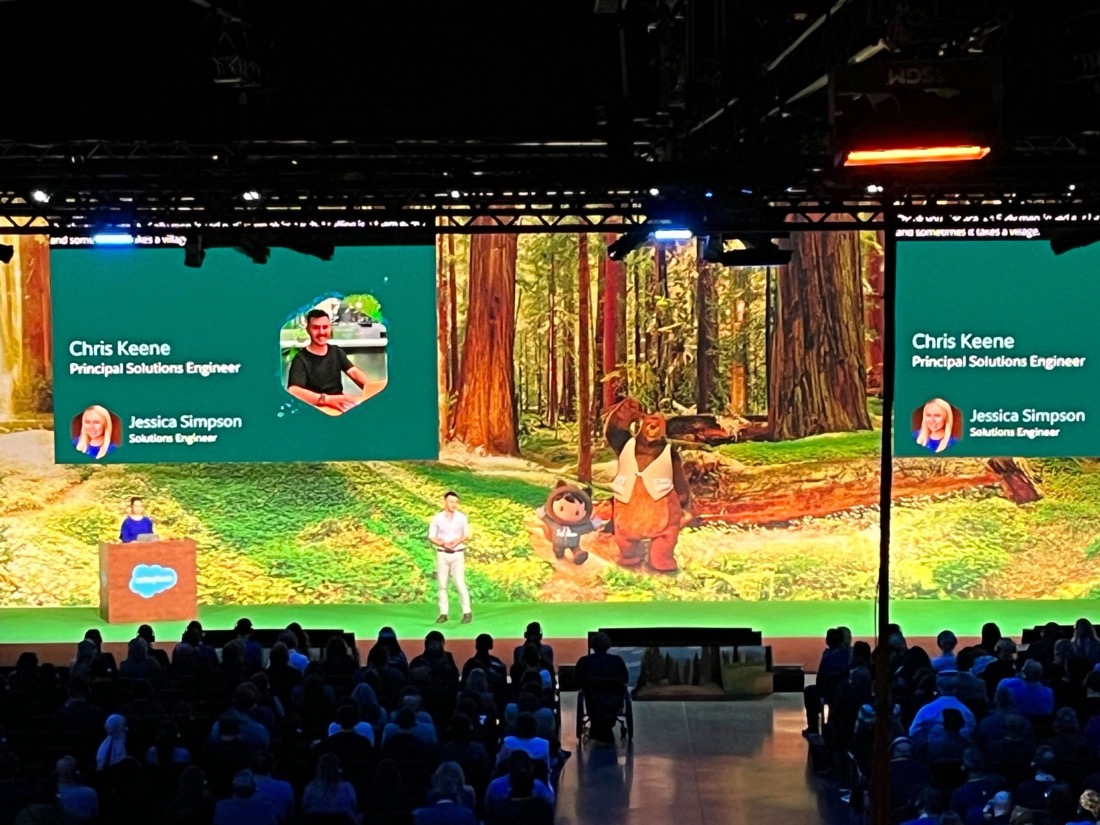
Chris on a large conference stage next to a co-presenter, his name and 'Principal Solutions Engineer' shown on the big screens.
Co-hosting the Sales Cloud keynote at World Tour (yes, that is a giant bear behind me).
Walking McLaren’s F1 drivers through building an AI agent. Quicker than a pit stop.
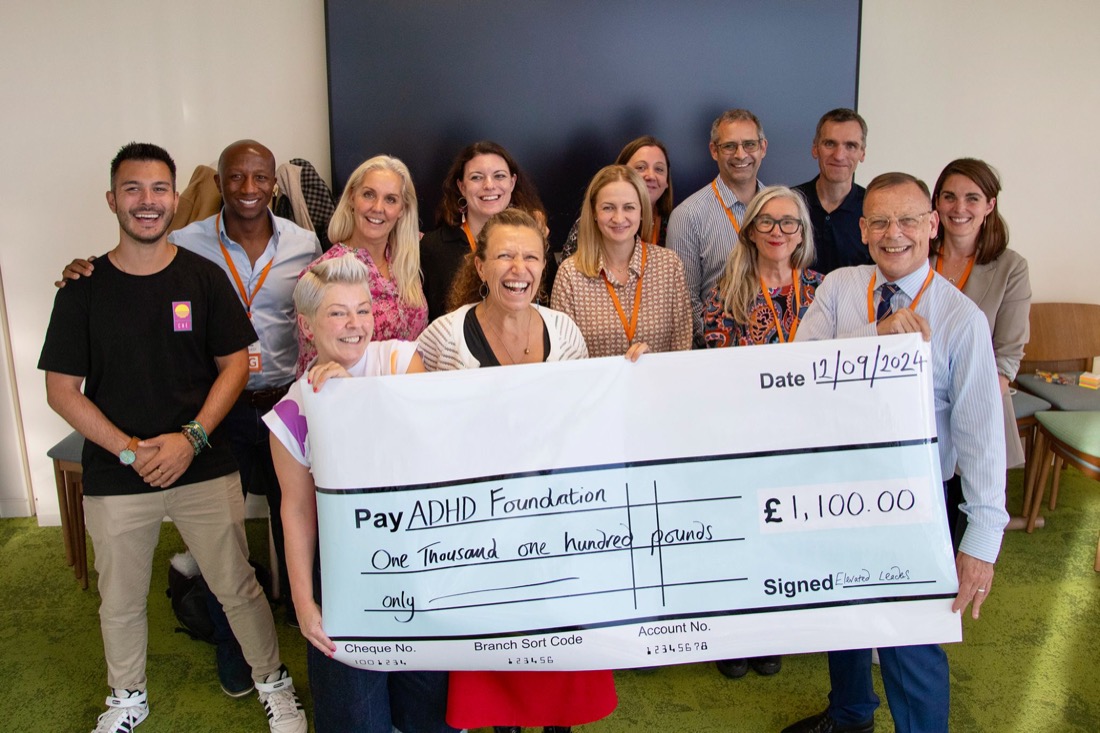
A group of about fourteen people holding a giant novelty cheque made out to the ADHD Foundation for £1,100.
The Elevated Leaders lot handing £1,100 to the ADHD Foundation. Close to home, this one.
Building an agent with Spurs’ CTO and a tech influencer in under the average Spurs stoppage time. Which, that season, was plenty.
Transcript

Here we go. Gents, nine minutes, 38, stoppage time for this year. We're gonna build an agent in that time. When you're building an agent, you don't need to know how to code. You just need to be able to essentially describe what you want it to do. I think for me, it's about making it as simple as possible for our fans, regardless of what they're trying to do with it. So we're gonna say, okay, we want it to make it simple, provide information about other experiences, help them with match day questions. If this agent, fan experience agent is able to do everything we said, what productivity would be unlocked? Yeah, the real benefit here is not just the fact that it can be built quickly, but you don't need to be super technical to build it. It feels like we might get it done in less than stoppage because while you guys were talking, we've now created the agent and it's deploying as we speak. Can we stop the clock on that one? Does that count? I think that counts. Oh, yeah, sorry, you gotta tell me. Eight minutes. Hey, look at that, we're a minute early. We've got the agent up and running here. Is this gear wheel spinning in terms of like, to really make the organization fully agentic? It unlocks what's possible for us. I mean, we made a decision to bring all of our capability into Salesforce and by doing that, there's lots of processes that you can unlock using agentic workflows. And given how easy it is to deploy these agents, we think we can deploy a lot of them quite quickly as well. That agent is now behind us. It's deployed. Run it, run it, Ted. We have it on our site. We have an agent running here. We are good to go.

Interviewed on the things I wish someone had told me when I started out as an SE.
Transcript

What would you say I should be landing now to prepare for the workplace tomorrow? So I think there's a lot of buzz around AI obviously and I think that's inescapable these days so tick the box for that one straight away but honestly I think one of the most important things that people could learn and practice is problem solving and curiosity so kind of understanding what you do and don't know and also going to see if you don't know something and you kind of accept that then how can I learn that going forward and how can I actually take that and move that on which I think is because if you look at how much everything's changed 6, 12 months ago Gen AI wasn't really a thing and then all of a sudden it's caught up in this massive wave of it coming through and I think the people that picked up on that early and when I'm going to teach myself about this I'm going to learn about it are the ones that are kind of best set up for that going forward and I think that's something that you can pick up and practice whether it's for that particular topic or anything else that will set you in really good stead.

What I do

A mix of what fills my week now and what I’ve spent years getting good at.

Solutions engineering & technical sales
Discovery, demos, POCs and technical evaluations for enterprise buyers. Turning “not sure” into signed, and sceptics into champions.
Accessibility engineering
My domain: WCAG 2.2, ARIA, assistive tech, and the manual keyboard and screen-reader checks the scanners miss.
Design thinking & service design
A decade of framing messy problems and designing services around real user needs. Certified practitioner, recovering consultant.
Leading & enabling the team
Levelling up the SE team with the onboarding, training and tooling I build, shaping new customer-facing roles from scratch, and setting how we all adopt AI. The part I care about most: making the people around me better.
Tool-building & automation
Small, sharp, self-contained tools, data viz, and AI pipelines that take the repetitive bits off people’s plates.
Front-end & creative coding
HTML, CSS, JavaScript, canvas, and the odd bit of computer vision when a project deserves to be fun.
Speaking & facilitation
Keynotes, industry-stage talks and workshops that make complex tech actually land with a room.
Social & marketing shoots
Scripting and presenting on-camera builds for social and brand campaigns, with F1 drivers, football execs and more. Turns out I’ve never met a camera I didn’t like, which is either a useful professional skill or a personality flaw. Possibly both.
New propositions & go-to-market
Shaping brand-new offerings end to end. I did the solutioning and market positioning for the UK’s first Salesforce managed service, Net Zero as a Service.

The road here

Mechanical engineer, turned consultant, turned solutions engineer. The through-line: design thinking, and making complex things click for people.

  1. Evinced 2025–now

    Principal Solutions Engineer, EMEA

    Technical lead on some of the biggest, most complex accessibility deals in the region, running discovery, demos, POCs and evaluations for banks, retailers and travel brands, helping them shift accessibility left across web and mobile and automate testing at scale. Increasingly I lead beyond my own deals: mentoring the EMEA SE team, shaping new customer-facing roles, and setting how we adopt AI. And I build the things that make the whole team quicker, ROI models, live demo environments, regression harnesses, and a library of AI assistants now used right across the team.

  2. Salesforce 2020–2025

    Principal Solution Engineer · President, Abilityforce UK

    Led technical sales for UK aerospace & defence and championed design thinking. Ran the Agentic Innovation Lab and a run of innovation workshops for 60+ customers, all pointed at good causes: sustainable innovation, ethical AI, and technology for disability equality. Helped launch the UK’s first Salesforce managed service, Net Zero as a Service, owning the solutioning and market positioning. Keynote speaker at Salesforce World Tour and the Farnborough Airshow, and President of Abilityforce UK, its disability-equality community.

  3. IBM 2012–2020

    Managing Consultant · Senior Consultant · European Large-Deals Team

    Championed design thinking (and qualified as a certified coach) with IBM’s biggest clients, led service-design engagements across energy, transport and public sector, and helped win over $500m of new business. On the side, I ran a 300-strong community of design professionals.

  4. Before that 2008–2012

    MEng, Mechanical Engineering · University of Sheffield

    Plus the formative stuff: a nuclear-waste engineering challenge, research into tennis-court physics, and the customer-facing years every good SE quietly runs on.

Certified: IAAP CPACC (accessibility)  ·  IBM Design Thinking Practitioner  ·  CIMA management accounting  ·  and a bit of French & Swedish

About

Hi, I’m Chris.

I’m a principal solutions engineer, covering EMEA. Day to day I’m the technical half of enterprise deals: demos, proofs of concept, and being the person who has to make the complicated bits make sense. More and more, that includes the team around me too, mentoring the other SEs, shaping new roles, and working out where AI actually earns its place. I got here in a fairly roundabout way.

I studied mechanical engineering, mostly because I like taking problems apart to see how they work, then fell into consulting for a decade, IBM and then Salesforce, doing design thinking and pre-sales for some very large clients. Accessibility wasn’t the plan. I first got into it, honestly, to impress a girl: I put on a day about technology and disability equality for more than 140 people, and quietly hoped she’d be watching. She was. We’re married now. It also turned into the best decision I’ve made. The people I met, the things I learned, the solutions I watched people build, I haven’t been able to leave it alone since.

So now it’s accessibility: making digital experiences work for everyone, whether they’re on a keyboard, a screen reader or their voice. And I build, a lot. Which still surprises me, because I was dead against AI before this job (“why would I ask AI when I can do it myself?”). I was wrong. Most of what I demo now, I’ve made myself, usually the night before.

Away from work you’ll usually find me falling out of a plane, under the sea, or off the side of a mountain: skydiving, SCUBA, speedriding, mountain biking and climbing. My mother despairs.

Chris skydiving in a red helmet, reaching toward the camera high above patchwork fields. Chris airborne on a mountain bike at a bike park, a chairlift and pine trees behind.

Writing

Occasional thoughts on accessibility, solutions engineering, and building with AI.

  • Loading…

Read everything →

Contact

Say hello.

If you’ve got an accessibility problem, a deal that needs a technical hand, or you just fancy talking shop, my inbox is open. I do actually reply.

hi@chriskeene.me

Lands straight in my inbox.